
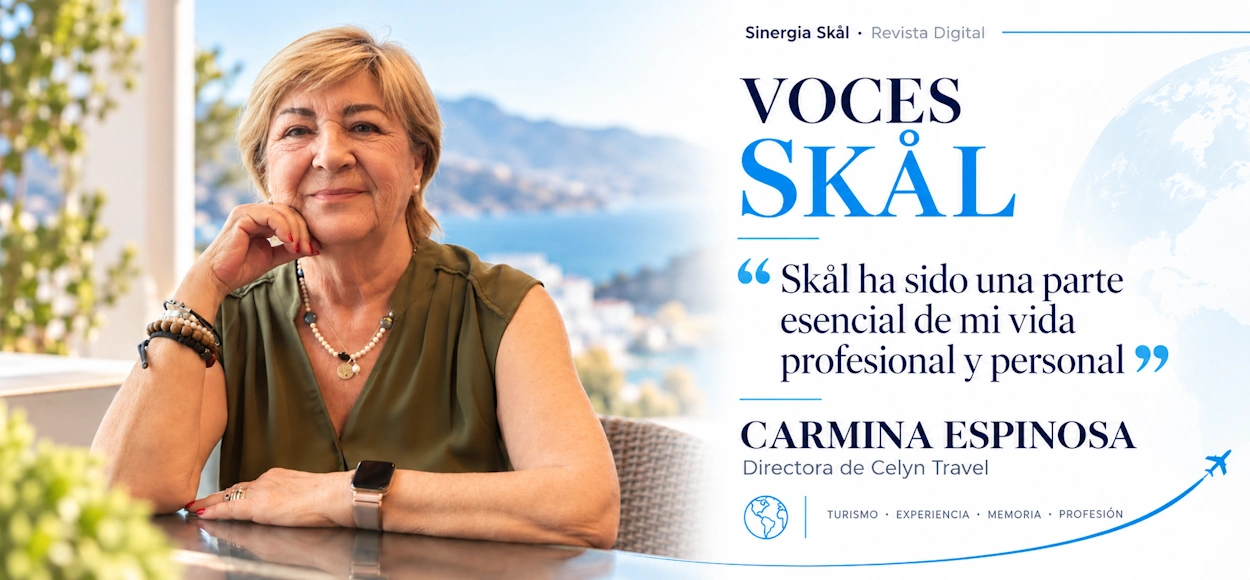
Skål Voices · Skål Synergy
Celyn Travel · Skål Málaga-Costa del Sol
Few professions have undergone such a profound transformation as travel agencies. From hand-written tickets and an almost artisanal relationship with the customer, we have moved on to an environment characterised by technology, immediacy and a much better-informed and more demanding traveller.
Carmina Espinosa has experienced much of that evolution from the inside. Carmina Espinosa’s career is linked to the world of travel agencies and to Celyn Travel, but also to the history of Skål itself: she worked for the organisation between 1987 and 1999 and experienced at first hand a particularly significant period, during which her brother Antonio Espinosa went on to serve as president Skål International in 1999.
Today, as a member of Skål Málaga-Costa del Sol, she brings a rather unusual perspective: she knows the organisation from the inside, through her own family and now also through her experience of belonging to the club. We spoke to her about tourism, travel agencies, memories, people and the future.
Carmina, you’ve been involved in tourism for many years. How did you get into the sector, and what do you remember about those early days in your career?
I ended up there by chance, although, really, it was down to “fate”. My true calling was medicine and surgery, but I had to enrol at university in Granada and live there. For many young women, this was difficult: leaving home and moving to another city was almost unthinkable in those days, not to mention the financial strain on a family with six children.
In Málaga, the only course available was teacher training, and I wasn’t keen on it, although my father insisted I enrol. I didn’t. That summer, thanks to a family connection, I joined Viajes Málaga (Top en Turismo) to pass the time, learn new things and, above all, see the world – even if it was only through brochures.
I had the “opportunity” to start a teacher training course in September, but during those months I enjoyed that world so much that I thought about making a career of it. Against my father’s advice, I enrolled on a course in Tourism Activities and Business Management — now known as Tourism — and was taken on by the agency. Needless to say, I paid for those studies myself through my job. I came to an arrangement with the college: some classes were attended in person and others were recorded.
You have witnessed several decades of transformation within the travel agency sector from the inside. What has changed the most in the relationship between the agency and the traveller, and what do you think remains essentially the same?
I have witnessed the transformation of travel agencies first-hand, particularly over the last thirty years, ever since I decided to pursue my dreams, my own path and my vision for the future. I founded Celyn Travel from scratch. It was then that I experienced first-hand the relationship between travel agent and client.
In my previous role, I worked for a company that catered to major tour operators from all over the world. There were about twelve of us, and each of us was responsible for a specific market. I was in charge of the French-speaking market: Belgium, France and part of Switzerland, including Airtours. We had a fixed working day back then: we started at 09:00 and finished at 17:00, with a lunch break.
Those of us who worked in this sector were fortunate. The relationship at the counter, with the customers, was harmonious; customers were open to advice and we always treated one another with respect.
These days, customers or travellers are far better informed and, at times, seem to know more than the professionals. They arrive armed with information from Google, from friends, from hotels that send offers directly to guests referred to them by agencies, and – needless to say – from our own suppliers and shipping lines.
There’s nothing quite like it. At least, that’s how I see it. Competition between us should bring out the best in us, but I think ethical standards are slipping. At least, that’s my view.
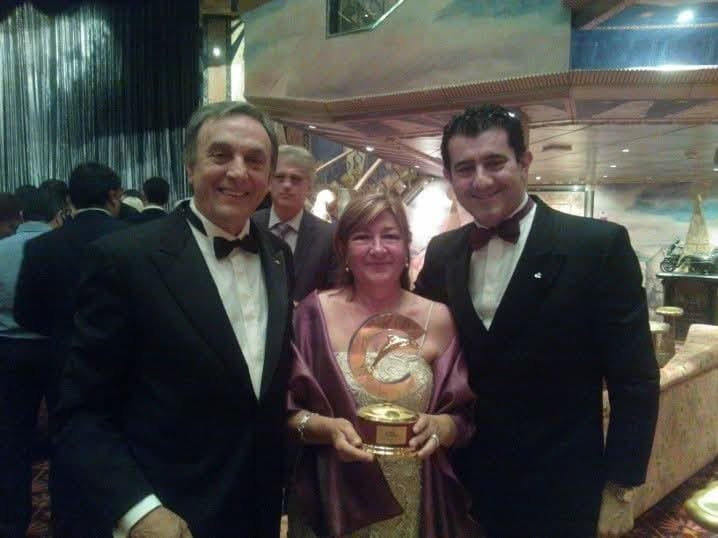
Between 1987 and 1999, you worked directly for Skål. What were your responsibilities, and what was the organisation like from the inside during those years?
When Viajes Málaga went bankrupt, I was still owed money right up until the very last day. We were just numbers to the owners. Back then, we were one big family.
It was such a tough time that I took a sabbatical to spend more time with my family. In 1987, I received a phone call offering me the role of secretary, liaising with Skål members at national level (FESC). The year before I joined, Antonio García del Valle had been International President (AISC).
I can’t quite remember how long my involvement with Skål was originally supposed to last, but I carried on until 1999, when Antonio Espinosa, my dear brother, stepped down as International President. I decided to make a change, professionally speaking, because I’d grown bored of doing the same thing for so many years… and so I set up the agency.
Twelve years is long enough to accumulate a wealth of experiences. Which people, moments or ways of working from that Skål do you remember with particular fondness, or do you consider important for understanding its history?
The most important thing is what Skål stands for: unity, cooperation, collaboration, a dream, friendship and being there when a member needs you.
I had two places from which I devoted myself to Skål: an office at Savitur and a desk next to Mr Claude Allegra at the Torremolinos Conference Centre.
I have very fond memories of Mr Miguel Gargallo, of the Gargallo Group and Skål Barcelona. Shortly after I arrived there, the three of us – he, my brother and I – went out for lunch. He was a powerful, kind and humble man.
And I also remember the vast majority of leading business figures, including Matute, Fluxá, Escarrer and many others. I also remember León Herrera, who had previously served as Minister for Tourism.
Moments – plenty of them. Anecdotes, too. I would attend small gatherings, taking notes of everything in shorthand, and although they were aware of my presence, they would still discuss personal matters. Everyone trusted me to keep things confidential, and I shall continue to do so for as long as I live.
In 1999, your brother Antonio Espinosa became President of Skål International. How did you personally experience that moment, and what did it mean for your family?
This is a difficult question to answer, but I’ll give it a go.
Antonio Espinosa was a very special person. He had a strong temperament — I’m like that too — but at the same time he was very humble at heart and such an intelligent man that everyone in my family admired him. Our conversations with our father were wonderful and so heart-warming that his laughter and ours were contagious.
My father had already passed away by the time he was elected. Had he been alive, Antonio would have told him about it without making a big deal of it. Of course, the rest of the family were delighted, but we took it in the same matter-of-fact way that he described it: it was just another award he’d received. Although Skål was his passion and he lived it to the full.
He wasn’t one for posing for photos, but he did celebrate any success with his true friends. Many of them were skålegas.
When you look back on that period today, is there any story, anecdote or aspect of Skål from that time that you think is worth preserving so that future generations don’t lose sight of it?
I don’t believe in the saying “the past was better”.
What I do recommend to younger people is that they take a look at the founders’ Code of Ethics, dating from the early 20th century. It is essential if you want to be a good skålega.
Having got to know Skål both as a professional within the organisation and through your own family, you are now a member of Skål Málaga-Costa del Sol. What does it mean to you to be returning in this new role?
These are two different periods in my life.
When I decided to leave, it was of my own accord. Over the last few years, Skål hadn’t been on my mind. This was largely because many professionals weren’t familiar with it, and it wasn’t active on social media, and so on.
‘Come back as a regular member? It’s all down to my friends on the Board of Directors,’ she smiles. I’m proud to be a member. I love Skål.
What do you still recognise about the Skål you knew decades ago, and what, on the other hand, has changed the most?
I’m not quite sure how to answer that.
The biggest change is that Skål used to be very exclusive when it came to accepting members. I’ve been turned down a few times. I prefer the way it is today: there’s more diversity, people are more open-minded and, I think, there’s more enthusiasm.
Once I’m able to attend a meeting, I’ll be able to give my views with a broader perspective.
By the way, I think the magazine, the club’s communications – everything – is a huge success. For many years, I hardly ever heard the name ‘Skål’, but now there’s hardly a day that goes by without someone asking me what it is. And then I launch into an explanation…
At Celyn Travel, you continue to champion a highly personalised approach to running a travel agency. In a market with so much information and so many options available, where does the true value of a good travel agent lie today?
The true value of a travel agent lies in putting themselves in the shoes of the person sitting opposite them. Connecting even without words and being honest. Offering what the customer needs and knowing how to gauge their financial means from the conversation, without actually asking directly.
And, of course, it goes without saying that he is a qualified professional.
Over the course of such a long career, there are moments when an agency shows that its responsibility goes far beyond simply selling a holiday. Which situations have particularly stood out to you in that regard?
A sale isn’t over once you’ve been paid and handed over the paperwork. The customer needs to know that, should any unforeseen issues arise at their destination, you’ll always be there for them. You have to earn that trust.
One incident that really left its mark on me was the bankruptcy of the shipping company Happy Cruises many years ago. I had chartered a plane for my group, flying from Málaga to Athens and returning from Venice to Málaga. The bankruptcy caught us by surprise whilst we were sailing in the Adriatic. One of the owners, Malik Alkarea, alerted me and sent a plane from Madrid to pick us up and bring us back to Málaga.
That three-day adventure – the last three days of the cruise – could easily serve as the script for a film. Malik, now at Kannak W2M, and I have been great friends ever since. He’s a wonderful man and I’ll never be able to thank him enough for what he did for me. And there have been other “adventures”, but they’ve always been there for me.
Technology, artificial intelligence and travellers’ changing habits are once again transforming the sector. How do you envisage the travel agency of the coming years, and what role will human interaction continue to play?
To be honest, I don’t have an answer. Our sector has changed a great deal, and I have a feeling it will continue to change.
We must keep fighting to survive, and that is achieved, almost certainly, by loving your profession.
You’ve experienced tourism and Skål from very different perspectives. After all that, what have you learnt about people, trust and relationships that explains why you’re still involved in this world?
I’ve learnt a great deal and I’m still learning.
I’ve met some wonderful people with whom I’ve remained close friends. The others have simply crossed my path and leave no mark unless you let them.
Why do I carry on? Because I still enjoy both my successes and my mistakes, and, ladies and gentlemen, this profession becomes an addiction – at least in my case.
Also because, despite having devoted my life to this world — the corporate sector, MICE, businesses… — I absolutely love this part of it. What’s more, when I organise a conference, it eventually becomes like a “child” to me. If I could go back, I’d do exactly the same. Teaching? No chance. I’m no good at it!