
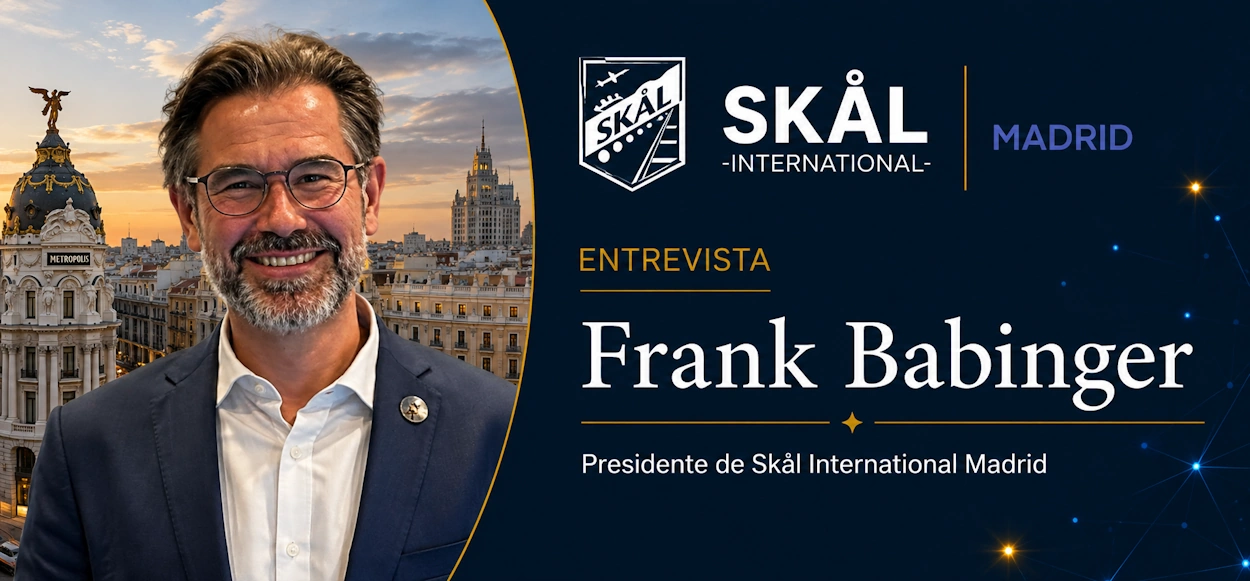
President of Skål International Madrid · Lecturer at the Faculty of Commerce and Tourism, Complutense University of Madrid
At the helm of Skål International Madrid is a professional who views tourism from a particularly interesting perspective. Frank Babinger combines his role as president of the Madrid club with university teaching and an academic career closely linked to tourism, the region and its development.
His day-to-day contact with those who will be the tourism professionals of the future, and at the same time with the business and professional community within the sector, provides a unique perspective from which to discuss the present and, above all, the challenges that lie ahead for Skål.
In ‘Skål in the Spotlight’, we spoke to Frank Babinger about Madrid, university life, the younger generation and the role Skål can play in the future of tourism.
1. Frank, you have just taken over as president of Skål International Madrid. What does it mean to you to be at the helm of the club, and what led you to take on this responsibility?
For me, taking on the presidency of Skål International Madrid is, above all, a great responsibility and also a source of immense excitement. Skål is an organisation with a long history and something that I consider particularly valuable in the world of tourism: the ability to bring together professionals from very different fields, build trust and create opportunities for collaboration.
I accepted this role because I believe we are at a particularly interesting juncture for tourism and also for Skål. The sector is changing rapidly, and we need forums that enable us to share experiences, knowledge and projects, whilst also bringing in fresh perspectives and new generations.
Drawing on my experience as a lecturer and researcher in tourism, but also on my relationships with professionals and organisations in the sector, I would like to contribute precisely to this: bringing together worlds that sometimes operate too independently of one another. Universities, businesses, institutions and young professionals have a great deal to contribute and a great deal to learn from one another.
I am therefore approaching this new phase with the aim of listening carefully, contributing and working to ensure that Skål Madrid becomes an increasingly active, open club that is closely connected to the tourism sector.
2. How would you define Skål Madrid And what do you think sets him apart within Skål?
Today, I would describe Skål Madrid as a meeting place for tourism professionals, but I think it is important to look a little beyond that definition. Skål has something that is particularly valuable: it combines professional relationships with friendship, trust and the opportunity to share experiences amongst people working in very different areas of the sector.
In the case of Madrid, we also have an extraordinary opportunity. We are in a cosmopolitan city, one of Europe’s major tourist capitals, where businesses, institutions, universities, associations and professionals from virtually every sector of the tourism industry come together. That diversity is, in my view, one of our club’s greatest strengths.
I would like Skål Madrid to become an increasingly open and dynamic meeting place, capable of bringing together both highly experienced professionals and those just starting out on their careers. I believe we need to make much better use of our ability to generate knowledge, contacts and projects.
And there is one thing I consider essential: Skål should not merely be an organisation that talks about tourism, but one that plays an active part in shaping its future. Madrid is undergoing a major transformation in the tourism sector, and our club has the opportunity to be part of that conversation, contributing the expertise of its professionals and linking it to the new realities of the sector.
3. You spend a large part of your professional life training those who will become the future professionals and managers in the tourism sector. What should Skål do to appeal to these new generations?
I believe that the younger generations don’t need us to explain to them why Skål is important; they need to find their own reasons for joining. And those reasons must be linked to their own concerns and to the professional reality they are set to experience.
Skål can offer you something that is incredibly valuable today: an international network of professionals, the chance to meet people from different areas of the tourism sector, share experiences, create opportunities and learn from those with extensive experience. But, at the same time, we must be willing to listen to what young people have to contribute.
I believe the challenge lies not only in bringing young people into Skål, but in making them feel like key players. Giving them the space, responsibilities and opportunity to get involved in the club’s projects and decision-making. And also making use of the new channels and forms of communication they are used to interacting with.
At university, I see every day that tourism students are keen and talented, but they need to connect with the professional world. This is where Skål can play an extraordinary role.
Ultimately, I believe we need to ensure that young professionals see Skål not as an organisation of the past, but as a network that can help them build their future. We must ensure and convey that Skål is the place where the experience of professionals and the talent of the younger generations come together and move forward jointly to improve international tourism.
4. You have emphasised the importance of linking universities with the professional reality of the tourism sector. Could Skål also act as a bridge between universities, businesses and new generations of professionals?
Absolutely. In fact, I believe it is one of the areas where Skål Madrid can add the most value. Universities and businesses need to work much more closely together, and an organisation like Skål can play a very valuable mediating role because it brings together professionals who have first-hand knowledge of the sector.
As a university, we can contribute knowledge, research, new perspectives and, above all, young talent. But we also need to listen more closely to businesses and find out what their needs are, what sort of professionals they are looking for, and what challenges they face.
Skål can help create these opportunities for people to meet. They do not necessarily have to be large-scale initiatives; sometimes a conversation between a student and a professional, a visit to a company, a talk, a joint project or a work placement can forge a connection that shapes a career path.
Furthermore, I believe the relationship should work both ways. Professionals can pass on their experience and knowledge of the sector to students, but they can also engage with the university to learn about new ideas, research and different ways of understanding tourism.
I would like Skål Madrid to help build precisely that bridge: a space where universities, businesses and young professionals are not separate worlds, but parts of the same tourism ecosystem.
Ultimately, the relationship between universities and business should not simply consist of universities preparing professionals for the business world; it should be a two-way dialogue. In this regard, we must ensure that Skål also serves as a gateway into the sector for young people and a gateway into university for professionals.
5. Madrid is currently experiencing a period of tremendous growth in tourism. From your dual academic and professional perspective, what do you think are the major challenges facing the destination, and what role can Skål Madrid play?
Madrid is currently enjoying a remarkable period from a tourism perspective. The city has been gaining international prominence, as recently confirmed by the Pope’s visit, Bad Bunny’s residency and the upcoming Formula 1 race, to name but a few.
It currently boasts an increasingly diverse and sophisticated range of offerings in cultural tourism, gastronomy, MICE and major events, and has great potential to strengthen its international standing even further. That is precisely why I believe the main challenge is no longer simply to grow, but to manage that growth in a balanced way.
Madrid must remain a competitive and attractive destination, but at the same time it must address issues such as coexistence with local residents, transport, pressure on certain areas, housing, environmental sustainability and the distribution of the benefits of tourism. And I believe this must be done without falling into the ‘tourism yes or no’ dichotomy. The debate should be about what sort of tourism we want and how we want it to contribute to the city.
In this context, Skål Madrid can play a significant role. We are an organisation made up of professionals who have in-depth knowledge of the tourism sector and who, moreover, bring a wide range of perspectives: accommodation, catering, transport, travel agencies, institutions, training, events, etc.
I believe it is our responsibility to take part in this debate by contributing our experience and knowledge, but also by listening to other stakeholders in the city. Skål Madrid can provide this forum for dialogue between the tourism sector, public institutions, the university and society.
Madrid does not simply need more tourism. It needs a form of tourism that helps to make the city a better place for those who visit it and, above all, for those who live there. It is clear that the success of the tourism sector brings new challenges and that Skål Madrid plays a vital role in helping to understand, tackle and manage these changes.
6. Your academic work has focused on tourism, the local area and sustainability. At a time of intense debate about tourism growth, how can we strike a better balance between competitiveness, sustainability, the local area and residents’ quality of life?
I believe we need to move beyond the idea that competitiveness and sustainability are conflicting concepts. In the long term, a destination that is not sustainable cannot be competitive either. The real question is how we can ensure that tourism generates value without passing on its costs to the local area and those who live there.
To achieve this, we first need to gain a better understanding of what is happening in our destinations. We cannot manage what we do not measure: tourist flows, spatial and temporal concentration, resource consumption, mobility, housing, environmental impact or residents’ perceptions. But data must be used to inform decision-making, not simply to compile statistics.
I also think we need to reframe the question. For a long time, we have been asking ourselves how many tourists we can attract. Perhaps we should be asking ourselves what sort of tourism we want, what value it brings, and what the region’s capacity is to accommodate it without damaging what makes the destination attractive.
And here, the quality of life of the residents must take centre stage. A tourist destination is not a setting created solely for visitors; it is, first and foremost, a place where people live.
At Skål, I believe we can contribute to this debate from a constructive standpoint. The tourism sector must be part of the solution: by innovating, reducing its environmental impact, creating quality jobs and collaborating with institutions and other stakeholders in the region. We, the professionals who make up Skål International, are – I repeat – part of the solution, as we understand the needs of the sector, but also those of the destinations and their residents.
Ultimately, it is not a question of choosing between tourism and sustainability. It is about ensuring that tourism is compatible with a liveable, competitive and sustainable region.
7. If you were speaking to a young tourism professional who isn’t yet familiar with Skål, what would you say to explain why it’s worth becoming a member of this organisation?
I would tell them not to wait until they have twenty years’ experience before starting to build their professional network. Tourism is, above all, a sector centred on people, relationships and shared experiences, and getting to know other professionals can be just as important as the knowledge we acquire at university, a training centre or in a company.
Skål offers precisely that opportunity: to meet professionals from very different backgrounds, to learn from them, to share ideas, to discover opportunities and, what’s more, to do so within an international network. It is, quite simply, the oldest and largest international network in the sector! Often, in our professional lives, a conversation, someone we meet or an opportunity that arises at just the right moment can change the course of our careers. Skål is that place, that environment, where connections are made.
But there is something I consider even more important. Joining Skål does not just mean receiving; it also means having the opportunity to contribute. The younger generations bring with them knowledge, fresh perspectives and different ways of understanding tourism, all of which are essential for any organisation to evolve.
That’s why I’d tell that young professional not to see Skål as something reserved for those who already have a long career behind them. On the contrary: the sooner they start networking with other professionals, getting to know the sector and building connections, the more tools they’ll have to forge their own path. In short, I’d say one very simple thing: come along, meet people, get involved and discover what Skål has to offer you. You’ll probably also discover what you can bring to Skål.
8. When your term as president comes to an end, what would you like to have contributed to Skål Madrid, and what sort of club would you like to leave behind for those who come after you?
First and foremost, I would like to make it clear that the previous presidents – every single one of them, each in their own way – have set the bar very high, and I have “inherited” the club in an unbeatable state. That said, when my term as president comes to an end – always with the understanding that I am supported by the Board of Directors – I would like to be able to look back and feel that we have succeeded in making Skål Madrid an even more open, dynamic club that is more closely connected to the realities of the tourism industry.
I would have liked to have helped bridge the gap between generations, bring in new professionals and strengthen the links between the business world, institutions and the university. But, above all, I would like members to feel that Skål is a place that brings them value, not only from a professional point of view, but also on a personal level.
I don’t think a president should consider leaving his name associated with a particular period. What matters is leaving the organisation stronger than it was when he took over and laying the foundations that will enable those who come after him to continue building on it.
I would like to leave behind a Skål Madrid that is better equipped to foster connections, knowledge, collaboration and opportunities; a club that upholds the values that have brought it this far, but which is capable of adapting to new generations and the changes taking place in the tourism sector.
And, above all, I would like whoever takes over the presidency after me not to feel that they have to start from scratch, but rather to find a well-established project on which they can continue to build in whatever direction they see fit. Because I believe that is the true responsibility of anyone who chairs an organisation: not to build something for oneself, but to help build something that will endure; with its changes, adaptations and developments, but always knowing where it comes from.
To finish, complete this sentence: «For me, Skål is…»
«For me, Skål is a professional friendship that connects, builds and moves forward into the future.»